
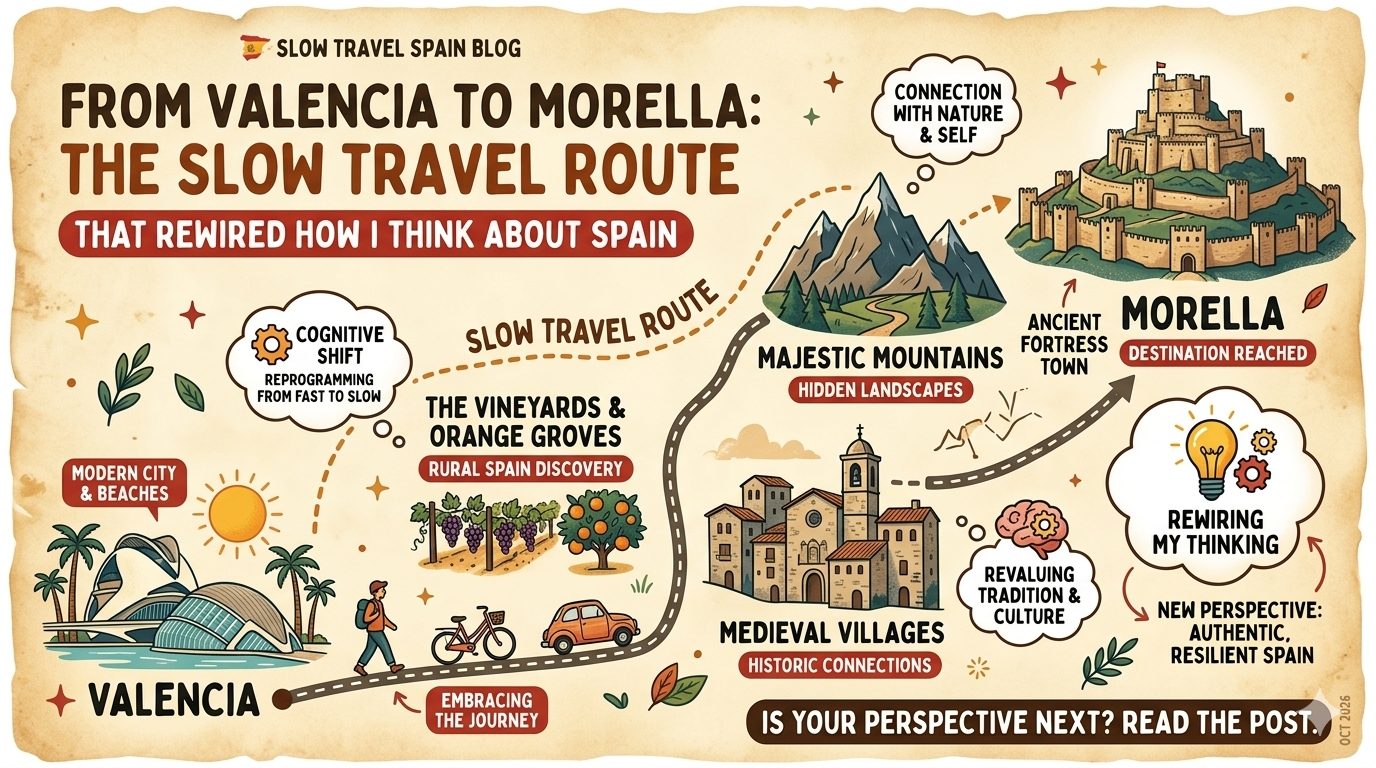
I had been to Spain eleven times before I turned off the motorway at Vinaròs and headed inland toward the Maestrazgo. Eleven trips, and every single one of them had followed the same coastal gravity — Barcelona, Valencia, Tarragona, the bright flat strip between the mountains and the sea where the food is good and the weather is predictable and the hotels outnumber the cemeteries.
The eleventh trip was when I finally admitted that I had been visiting the same country repeatedly without actually exploring it.
The route from Valencia to Morella takes around two and a half hours and covers a distance that feels, by the end, much longer in the best possible way. You leave the AP-7 corridor at Vinaròs and begin climbing immediately. The landscape changes fast — rice paddies and orange groves give way to olive terraces, then to a rougher terrain of rock and juniper and the particular bone-coloured scrub of the Iberian interior. By the time you reach the CV-14 heading west, you are in a different Spain entirely. Quieter. More vertical. Less interested in explaining itself to visitors.
The Road as Part of the Trip
This is not a route where you want to be in a hurry. The road through the Ports de Morella natural park winds through a landscape that rewards stopping — not at designated scenic viewpoints with information panels, but at the kind of unmarked lay-by where you pull over because you have suddenly registered that the valley below you contains no visible human infrastructure and the light on the far ridge is doing something worth looking at for a few minutes.
I stopped four times on the drive up, which should have taken ninety minutes from Vinaròs and instead took three hours. I did not feel that any of that time was wasted.
The villages on this road — Cervera del Maestre, La Jana, Canet lo Roig — are the kind of places that digital nomad content has not found yet. Small bars with handwritten menus, churches that are usually locked but occasionally open on Sunday afternoons, the particular social physics of a village where everybody knows the history of every family going back four generations. If you have the time and a Spanish vocabulary sufficient for basic transactions, stopping for lunch in any of these towns is worth it.
Arriving in Morella
The approach to Morella is one of the most legible architectural experiences in Spain. The town is visible from several kilometres away — a limestone mass on a ridge, walls wrapping the entire settlement, the ruined castle rising at the summit. It looks like what it is: a place that was built to be defended, that survived everything thrown at it, and that has been inhabited continuously since before recorded Spanish history begins.
The roads into the old town are steep and narrow. Most accommodation requires leaving your car outside the walls and carrying luggage on foot through one of the medieval gates. This is an inconvenience that immediately recalibrates your sense of pace. You cannot be in a hurry in Morella. The place will not allow it.
The Specific Quality of Silence Here
I work remotely, which means I am always looking for places where the two requirements of good remote work — reliable internet and genuine disconnection from distraction — coexist in ways that cities almost never manage. Morella is unusual in that it delivers both.
The accommodation in the historic centre typically has solid broadband. The town is quiet enough that you can think in complete sentences. The view from most windows is either the medieval roofscape dropping toward the plains or the castle above, which provides a kind of temporal perspective that is oddly useful when you are trying to solve problems that feel urgent at nine in the morning and absurd by three in the afternoon.
The coworking infrastructure is nonexistent in the formal sense — there is no WeWork with exposed brick and artisanal coffee. What exists instead is the dining room of your accommodation in the morning, a bar with good wifi and no background music by midday, and an almost total absence of the social pressure that open-plan offices generate. I got more focused work done in four days in Morella than in the preceding two weeks in Valencia.
One practical note for digital nomads working through multiple platforms: small towns and rural accommodations often use local WiFi portal systems that ask for an email registration to grant access. For those single-use signups where you have no ongoing relationship with the provider, a disposable email prevents the minor administrative accumulation of accounts you will never use again. It is a small thing, but when you are managing remote work across multiple locations, small things compound.
The People Who Are Building Things Here
On my second afternoon, I walked into a small ceramics workshop on Calle de la Virgen that had clearly been recently renovated. The woman running it — I will call her Elena, which is close enough — was in her early thirties and had moved back to Morella three years earlier after a decade in Barcelona to restart the family’s ceramic tradition, which had died out with her grandfather.
She was in the process of rebranding, she explained, because the original family name for the workshop was a local dialect word that meant nothing to online audiences outside the immediate comarca. She had spent weeks trying to find a name that preserved some reference to the region’s craft tradition while being searchable by the kind of European design tourists she was targeting.
What had eventually worked, she said, was running her shortlist of concepts through an AI name generator to get lateral associations she had not considered — unexpected combinations that pointed her toward a direction she found herself actually excited about rather than just settling for. The resulting name was hers, not the machine’s, but the machine had moved her off a creative block she had been circling for months.
I mention this not as a digression but because it is representative of something I noticed across Morella’s small entrepreneurial community: people who are building genuine craft and hospitality businesses in a difficult economic geography, using whatever tools are available to them, taking the long view because the short view in a town of three thousand people has obvious limits.
What the Slow Route Actually Gives You
The fastest way to understand what Morella is would be to read a guidebook entry, look at photographs, and form an accurate cognitive map of the town’s history and geography. This is possible. It is also almost entirely useless.
What the slow route — the off-motorway drive through the Ports, the stop in La Jana for a sandwich, the three hours instead of ninety minutes, the luggage carried through the gate on foot — gives you is something different. It gives you the physical memory of how this place sits in the landscape. The way the altitude changes the air temperature noticeably by the time you reach the walls. The way the views from the road prepare you for the views from the castle in a way that photographs do not. The way arriving tired and slightly disoriented from mountain roads makes the discovery of a warm dining room feel genuinely earned rather than simply scheduled.
Spain has spent decades building infrastructure designed to make its most famous places easier to reach. The consequence of that infrastructure is that its most interesting places — the ones that require effort, that reward preparation, that cannot be done as a day trip from a coastal resort — have become proportionally more valuable.
Morella is one of those places. The road up is the beginning of understanding it, not an obstacle to it.
Making the Journey
The best time to make this drive is early morning or late afternoon, when the light on the Maestrazgo landscape is doing the most work. The road is emptiest mid-week in the shoulder seasons. Budget four to five hours from Valencia city centre to arriving in Morella with bags unpacked, which allows for a stop or two along the way.
Book accommodation in the historic centre if you can. The experience of staying inside the walls is categorically different from staying in the newer village below — not because of amenities, but because of what you wake up to. The morning light on medieval stone has a specific quality that no description captures accurately and that you will think about, in the way you think about genuinely good experiences, long after you have driven back down the mountain toward the coast.