
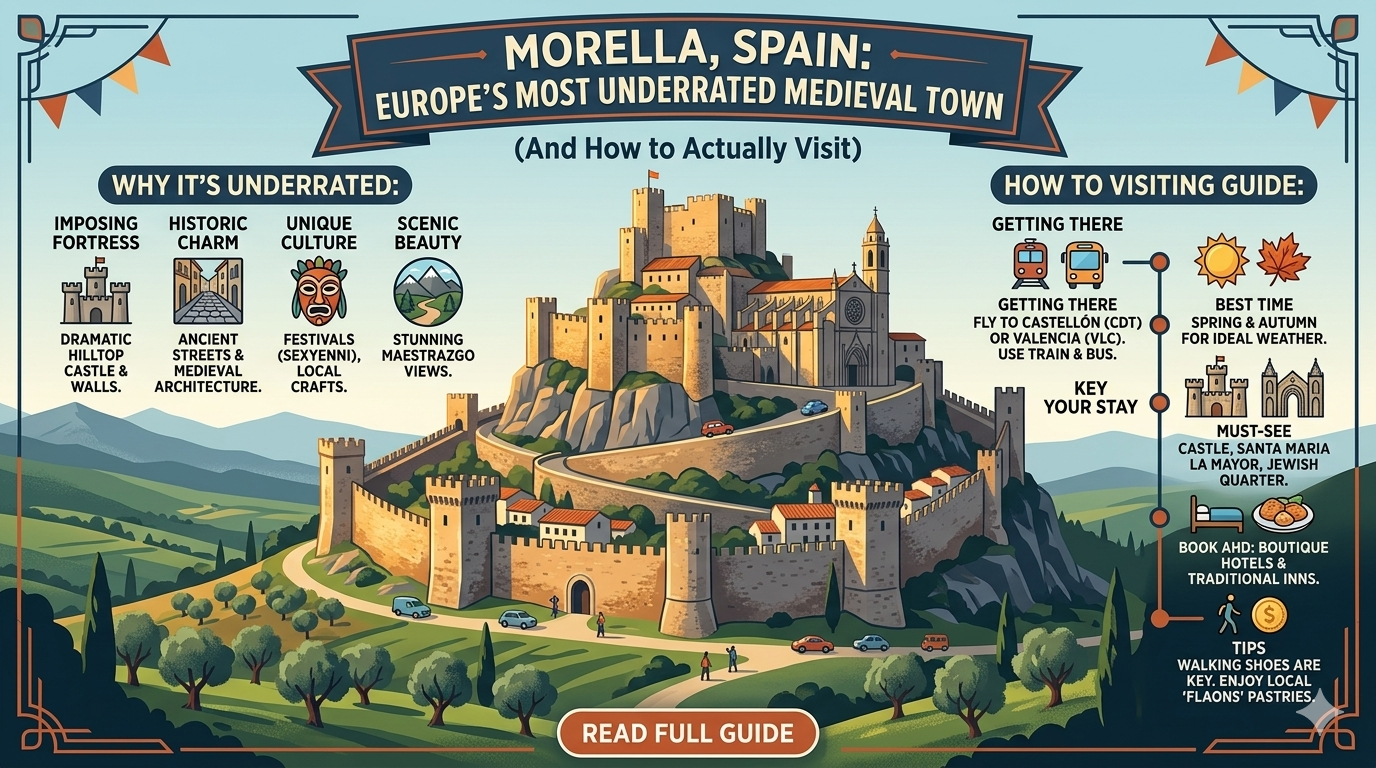
There is a town in eastern Spain that has been continuously inhabited since before the Romans arrived. It sits on a limestone outcrop at 1,004 metres above sea level, completely enclosed by a two-kilometre wall that has never been breached by an invading army, crowned by a castle that has watched empires rise and dissolve in the plains below it. On any given weekday in the off-season, you might walk its cobbled streets and encounter fewer than fifty other visitors.
That town is Morella. And almost no one outside Spain knows it exists.
This is not an accident. Morella is not on the way to anything. It requires deliberate effort — a decision to turn off the motorway and climb thirty kilometres of mountain road into the Maestrazgo highlands — which is precisely why it has remained one of the most intact medieval urban environments in all of Europe. The tourists who discovered Toledo and Segovia decades ago never found their way here. Morella kept its secrets.
If you are the kind of traveller who has grown tired of fighting crowds at the Cathedral of Santiago or queuing for the Alhambra, Morella is the antidote you did not know you needed.
What You Are Actually Looking At
The visual impact of Morella on first approach is difficult to overstate. Driving up from the AP-7 corridor, the town reveals itself gradually — first the crenellated walls climbing the hillside, then the Gothic bulk of the Basílica de Santa María la Mayor, and finally the ruins of the castle at the summit, fragments of towers silhouetted against sky that in this part of the world is almost aggressively blue in autumn and winter.
The walls are original. Not restored-to-the-point-of-being-fake original, but genuinely medieval, complete with erosion marks, patched stones where sections collapsed centuries ago, and gates that are still the primary entry points into the town. Walking through the Puerta de San Miguel or the Portal de Sant Mateu, you cross a threshold that is not merely architectural — you pass from the twenty-first century into something considerably older.
Inside, the street layout has barely changed since the thirteenth century. The main commercial artery, Calle Blasco de Alagón, follows the same line it has followed for seven hundred years. Covered arcades — locally called porxes — protect pedestrians from rain and sun exactly as they were designed to do in the medieval period. Houses of golden limestone press close on either side, their wrought-iron balconies trailing geraniums in summer, their carved stone doorways wearing the faint heraldic devices of families who have long since moved elsewhere.
The Monuments Worth Your Time
The Basílica de Santa María la Mayor is the centrepiece and deserves more than a hurried circuit of the nave. Construction began in the fourteenth century and continued into the sixteenth, which means the building contains Gothic, Renaissance, and late medieval elements in the kind of layered complexity that no single architectural period can produce on its own. The carved portal on the south façade — the Apostles’ Door — is exceptional; the figures in the jambs have the slightly awkward vitality of work produced before sculptors had entirely solved the problem of depicting natural human movement in stone.
The castle at the top of the hill requires a climb, but the views from the upper platforms justify every step. On a clear day in winter, after the first snows have fallen on the Penyagolosa massif to the southwest, the panorama extends across ridges and valleys that contain almost no human infrastructure visible from this height. It looks, frankly, like the opening shot of a fantasy film.
The medieval aqueduct outside the walls — three tiers of arches crossing a ravine — is easy to miss if you do not know to look for it, but it appears on no major tourist map and you will almost certainly have it to yourself.
The Food Question (Which Is Also the Truffle Question)
Morella sits in the Maestrazgo, one of the most agriculturally distinct regions in Spain. The highland plateau supports a style of cooking that has more in common with the mountain cuisines of Aragon and southern Catalonia than with the rice and seafood culture of the Valencia coast below. This means slow-cooked stews built around locally raised lamb and pork, game in season, and, most significantly for visitors who know what to look for, truffles.
The black truffle harvest in Morella and the surrounding villages runs from approximately November through March, and the town celebrates with an annual Truffle Fair (Fira de la Tòfona) that draws serious food tourists from across Europe — though serious in this context means a few hundred people rather than the thousands who descend on truffle festivals in the Périgord or Umbria. Local restaurants during truffle season offer tasting menus that would cost three times as much in any major Spanish city.
Outside truffle season, the food culture is still worth the journey. Look for dishes built around the trufa de verano (summer truffle), locally cured sausages, and roast lamb from herds that graze the surrounding sierra. Casa Morella and similar heritage properties often serve food that draws directly on this tradition — cooking that tastes specifically of this landscape and could not be replicated anywhere else.
The Practical Logistics (Which Are Not as Hard as They Sound)
The main obstacle most international visitors cite is transport. Morella has no train station and the bus connections from Valencia (the nearest major city, roughly 170 kilometres south) are infrequent. The honest answer is that a car makes this trip significantly easier and opens up the surrounding comarca for day trips to villages like Forcall, Cinctorres, and Vallibona.
If you are planning your journey from abroad, setting up price alerts for trains to Valencia and budget flights is straightforward, though it does mean subscribing to a handful of booking and comparison platforms. If you prefer not to let those signups colonise your primary inbox, using a temporary email address for that research phase keeps things clean — the alerts land in a disposable inbox while you compare options, and you switch to your real contact details only when you commit to a booking.
Getting to Morella itself takes approximately two and a half hours from Valencia by car, following the A-23 north before cutting east on the CV-14. The road in the final stretch climbs through juniper scrubland and rocky outcrops in a way that makes the arrival feel genuinely earned.
When to Go
The conventional wisdom says spring and early summer for the wildflower meadows and mild temperatures. The contrarian answer is November through February, when the tourist infrastructure drops to near-zero, the truffle season is running, firewood smoke drifts over the walls from early afternoon, and the town settles into a pace that bears no resemblance to the performance of itself that any heritage destination is obliged to put on for summer crowds.
The Sexenni festival — a unique religious and cultural celebration held once every six years — is worth planning a trip around if the calendar aligns. The next edition draws significant attention even outside Spain.
For Travel Writers and Bloggers
Morella is genuinely underserved in English-language travel content. A search for the town’s name in most major travel publications returns a handful of dated articles and almost nothing aimed at contemporary slow-travel audiences. For anyone building a travel content operation and looking for territory with real keyword opportunity and minimal competition, this is the kind of place worth covering thoroughly.
Getting that content indexed and discoverable requires the technical infrastructure that often gets deprioritised in the rush to publish — structured sitemaps, proper XML submission to search engines, and clean site architecture. A sitemap generator handles the technical side quickly, which means less time in setup and more time writing about places like this one.
Morella will not remain undiscovered indefinitely. The slow-travel movement has a way of finding exactly these places, and when it does, the window for covering them as genuine hidden gems closes fast. The wall has kept armies out for seven centuries. It cannot keep the algorithm out forever.